
Use the MHQ in your research
The Mental Health Quotient (MHQ) is a next-generation, transdiagnostic assessment of mind health, validated across millions of respondents worldwide. There are several ways to bring it into your study: a free paper version with a scoring calculator, an API integration into your own application, or our custom MHQ platform, configured by our team to your specifications.
Self-report assessment · Not a diagnostic tool · Built for population and clinical research
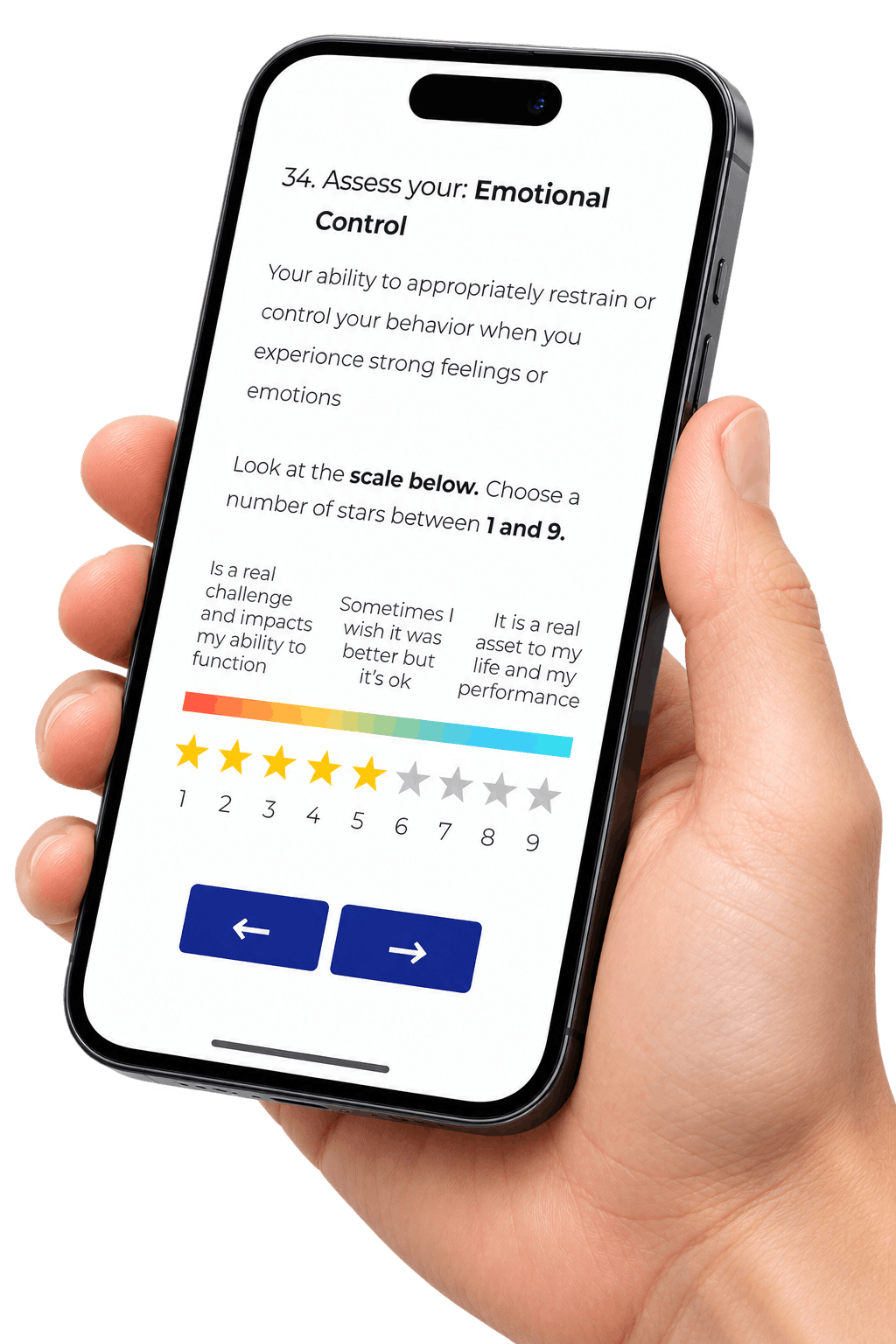
Key elements of the MHQ
What researchers do with the MHQ
Because the MHQ produces both an aggregate score and granular dimension and item-level detail, it supports research questions a single-purpose symptom checklist can’t.

Measure a population against the world
Score the mind health of a population, community, or workforce and compare aggregate and dimension results against Global Mind Project norms.

Quantify intervention impact
Field the MHQ before and after a program, policy, or intervention to see how much it actually moves aggregate mind health and which dimensions shift.

Study social determinants
Use the lifestyle and life-circumstance items to see how social and environmental factors relate to aggregate scores, and to specific capacities and problems.

Compare efficacy across symptom profiles
Break results out by symptom profile to see how a treatment or intervention performs for different populations, not just against a single diagnosis.
Several ways to bring the MHQ into your study
However your research is built, there’s a way to field the MHQ that fits it — from a free paper-and-calculator option to a custom MHQ link configured by our team. The MHQ is available for adults 18+ and for youth ages 12–17, so you can run age-appropriate research across the lifespan on a comparable scoring framework. MHQ scores and reports are proprietary to Sapien Labs and are only available through the scoring calculator, API, or Sapien Survey platform; the MHQ questionnaire itself may be used in other survey tools, but scoring must be processed through one of these three routes.
Free
Paper version + calculator
Free for academic researchers running pen-and-paper data collection. Upload completed response files to the Sapien Labs scoring calculator and get proprietary MHQ scores back.
Custom setup
Sapien Survey platform
Share your study specifications with our team and we’ll configure a branded MHQ instance for you. You get a single shareable link, automatic scoring, reports, and aggregated data — no engineering required. All instances include access to raw response data and calculated scores for download.
Developer
API integration
Build your own front end and call the MHQ API directly to receive proprietary scores and reports inside your own application or existing survey tool.
No-code
Webhook
Build your assessment in Typeform and receive proprietary MHQ scores back through a webhook integration with the Sapien Labs scoring engine.
How Sapien Survey works
Sapien Survey is our custom MHQ link platform — tell us your study specifications and our team will configure your instance, so you can share one link and have scoring happen automatically.
01
Configure your instance
Brand your survey and add your own questions — demographics, lifestyle factors, study-specific items — alongside the core MHQ.
02
Distribute to respondents
Share a single survey link with your participant pool. Respondents complete it on any device in about 15–20 minutes.
03
Generate scores & reports
Choose what each respondent sees on completion — nothing, an on-screen score, or a full personalized self-help report.
04
Download & aggregate
All instances include access to raw response data and calculated scores for download. Pull pre-built aggregated tables across one or many survey instances for your own analysis.
Compare your data to the Global Mind Project
Every MHQ score you collect can be put in context against the Global Mind Project — Sapien Labs’ continuously growing database of mind health profiles from the internet-enabled population, now covering more than 2.7 million people and adding thousands more every day.
2.7M+
profiles in the Global Mind Project, and growing
130
countries represented
1,000+
new responses added daily
Use it to benchmark your sample’s MHQ scores against country, age, and demographic norms. You can request access to the database through the Researcher Hub.
All the ways the MHQ has been validated
The MHQ has been validated against clinical diagnosis — negative scores correspond to the presence of one or more psychiatric disorders, while those with positive scores have less than a 1% chance of a psychiatric disorder. It has also been validated against functional productivity, demonstrating that higher scores track directly with a person’s ability to work, study, and engage in daily life. It has further been shown to produce consistent results across independent samples and to be reliable on re-test, and these properties hold across 25+ languages, making it robust for cross-cultural and international research.
Clinical validation
MHQ score vs. % meeting criteria for at least one psychiatric disorder
[ Insert clinical validation chart ]
Functional productivity
MHQ score vs. days unable to work or study in the past month
[ Insert functional productivity chart ]
Pay for what your study needs
Set-up is priced per survey link, and participant-facing reports are billed per response — so a 50-person pilot and a 50,000-person population study scale the way you’d expect. Academic pricing applies to non-commercial research at degree-granting institutions and registered non-profits. Paper versions remain free for academic researchers. For commercial pricing, contact us →
For university & non-profit research
Our team will configure your custom MHQ link based on your study specifications.
| Set-up per link | |
| Standard MHQ | $100 |
| Custom, up to 5 questions | $250 |
| Each additional question | $20 |
| Per response | |
| No report to participant | $0.25 |
| On-screen scores and brief report | $1 |
| Personalized self-help report | $3 |
Expecting more than 1,000 respondents? Contact us for discounted pricing →
Bring the MHQ into your next study
Get in touch and our team will help you choose the right approach for your research.