
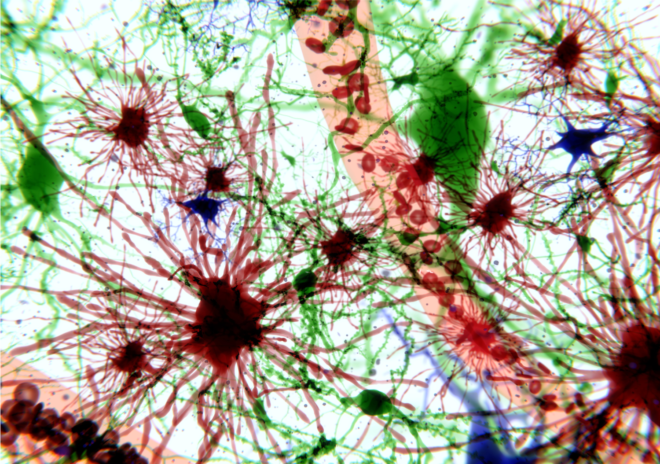
Over the last decade or so it has been found that astrocytes exert control over synapse formation, synaptic transmission, blood flow and host of other things suggesting that they may be the cells in the brain that are really in charge.
The prevailing view of the brain is heavily neuron centric so much so that the study of the brain is called ‘neuro’science and brain networks are ‘neural’ networks. Yet the more we learn about glial cells, and astrocytes in particular, the more it begins to look like, if there is a hierarchy among cells, then it is these cell types that are really in charge.
Types of Astrocytes
Astrocytes are a type of glial cell. They are star shaped which is to say they have a cell body with lots of processes. Just as with neurons, there are a large diversity of astroctyes based on morphology and key protein markers. In mice, at least, there are two broad subtypes of astrocytes – one called a protoplasmic astrocyte that lives in the grey matter and has highly branched bushy processes and another called a fibrous astrocyte that lives in the white matter and has straight long processes and express high levels of an intermediate filament protein called glial fibrillary acidic protein (GFAP). Not a whole lot is known about fibrous astrocytes, but protoplasmic astrocytes have been pretty well studied. In humans the subtypes of astrocytes are even greater. Furthermore, they are much larger in size with more complex branching.
see related post From Mouse Brain to Human Brain
So what do these astrocytes do? Here are three big things.
1) They control neurogenesis and synapse formation
It’s been known for a few decades now that astrocytes are crucial for the survival and health of neurons. Astrocytes secrete factors that greatly increase the number of structural synapses that neurons form and also play an important role in determining the correct timing of structural synapse formation. Essentially neurons are unable to form synapses until they are physically contacted by an astrocyte.
2) They exert control over synaptic transmission
In mice, a single protoplasmic astrocyte in the cortex wraps around multiple neuronal cell bodies and up to 600 dendrites and, through its finer processes, makes contact with ∼100,000 synapses. In humans astrocytes, with much larger and complex branching, they make contact with a much greater territories and a much greater number of synapses. Through these contacts, they form a tight structural interaction with the synapse through which they can sense neurotransmitters, monitor synaptic activity and exert control over it. Astrocytes are also involved in enabling the production and clearing of neurotransmitters. This modulation of synaptic activity is a dynamic process and like the spines of dendrites in neurons, astrocytic processes undergo constant change and restructuring. Interestingly, each astrocyte has its own domain that does not overlap with that of another astrocyte. Essentially the astrocytes seem to oversee communication among a set of neurons and/or synapses and perhaps has the capability of coordinating or orchestrating activity across a large number of synapses.
3) They control blood flow and therefore access to energy
Astrocytes extend endfeet to blood vessels and wrap around them to form a limiting membrane, which is the outermost wall of the blood brain barrier. This likely means that they exert some level of control on what gets through to neurons in terms of biomolecules. They also regulate vasodilation of blood vessels, controlling the rate of local blood flow in response to activity levels.
And these are by no means the only things that astrocytes. But they are enough to see they are pretty significant. I’d lay my bets on the elements of a system that control how its network are set up, control and coordinate how signals are transmitted and control the flow of energy as the ones in charge.
see related post Einstein, Astrocytes and EEG
What does this mean for other domains of ‘neuro’science?
With most sub domains of neuroscience growing up ignoring glia there is probably a lot of rethinking to be done. For decades much of the interpretation of the literature on synaptic transmission in the brain ignores the glial element (we certainly did in my PhD lab, pretty much killing off as much of the glia as possible in our cultures to study neurotransmission – we didn’t know all this back then). Similarly, most of computational neuroscience ignores the glia altogether. Even today there are hardly a handful of computational papers that attempt to include the influence of glia. If a single astrocyte is responsible for coordinating and regulating hundreds of thousands of synapses in an activity dependent manner, how can any model that excludes them shed any real light on the mechanisms of the brain?
Altogether it seems like glia are a pretty big deal and they are coming to turn some paradigms upside down.
References
[1] Diverse subtypes of astrocytes and their development during corticogenesis Tabata H. Front Neurosci. 2015;
[2] Astrocytes Control Synapse Formation, Function, and Elimination, Chung W.S et al, Cold Spring Harb Perspect Biol. 2015
[3] Astrocyte-mediated control of cerebral blood flow.Takano T. et al, , Nat Neurosci. 2006 Feb;9(2):260-7.
Great article! The astrocyte research community is happy with the recognition.