
GLOBAL MIND DATABASE
Researcher Hub
The Global Minds Research Platform is a comprehensive research ecosystem designed to power global insight into mental wellbeing.
It encompasses the world’s largest real-time dataset on mind health, collected using the MHQ, a validated assessment of cognitive, emotional, and social functioning, together with a scalable, multilingual data acquisition system.
Researchers can analyse existing data, deploy custom studies across 130+ countries, and explore how life context, technology, and culture are shaping the mind at population scale.

Download the Brochure
SCALE AND SCOPE OF THE DATA
Scale of the data
- 2M+ Respondents
- 163+ Countries
- 23 Languages
Scope of the data
- 47 Parameters of Mind health & Wellbeing
- 40+ Life Context Factors
- 20+ Adversities & Traumas
The database offers the world’s largest source of real-time global data on 47 mind health parameters, combined with detailed demographic, lifestyle, and social context information from the internet-enabled population.
OPEN ACCESS RESEARCH
The data is freely available to all researchers from academic, nonprofit and governmental organizations.
Data can be used for numerous research purposes including
Summary and Sample of the Data

SOCIAL DETERMINANTS OF MENTAL HEALTH

COMPARING MENTAL HEALTH ACROSS THE GLOBE

TRACKING OF MENTAL WELLBEING OVER TIME

HELP SEEKING BEHAVIORS AND BARRIERS

STRUCTURE OF SYMPTOM NETWORKS

DIVERSITY OF MENTAL HEALTH PHENOTYPES
“The Global Mind data has a scale, breadth, and timeliness that have not been available before and is one of the richest and most topical datasets I have worked with.”
David Blanchflower
Bruce V Rauner Professor of Economics, Dartmouth University
FEATURED DATA DOMAINS
The project collects in-depth demographics and life context factors to facilitate research on high priority areas including, but not limited to:
- Age & Gender
- Geography
- Educational attainment
- Employment status
- Household income
- Treatment and Help-seeking
- Medical conditions
- Substance use
- Adverse childhood experience
- Adverse experiences during adulthood
- Family relationships
- Friendships
- In-person socializing
- Religion & spirituality
- Work culture and structure
- Processed food consumption
- Fruit & vegetable consumption
- Sugar consumption
- Plastics use
- Physical exercise
- Age of smartphone & tablet ownership
- Social media use
To request access to the data
DATA SOURCE
Data is collected through the MHQ, an anonymous online tool that is free for anyone aged 18 and over. It takes 15–20 minutes to complete and provides each participant with a personalized report upon completion



This validated, transdiagnostic assessment gathers data on 47 aspects of mind health and wellbeing, along with a wide range of demographic, lifestyle and life context factors
Validation of MHQ Assessment
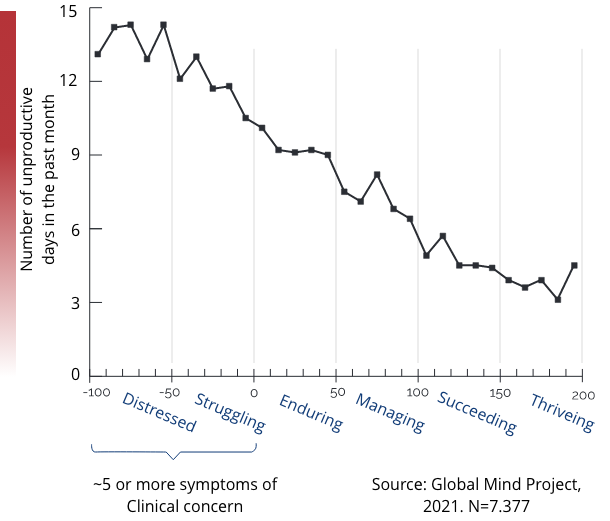
Global Mind data includes a unique aggregated metric of Mind Health and Wellbeing (the MHQ score) that positions individuals on a spectrum from distressed to thriving and relates linearly to productive days.
Data also includes scores across 6 different dimensions of Mind Health and Wellbeing:
- Mood & Outlook
- Social Self
- Mind‑Body Connection
- Cognition
- Adaptability & Resilience
- Drive & Motivation
To request access to the data
GLOBAL REACH
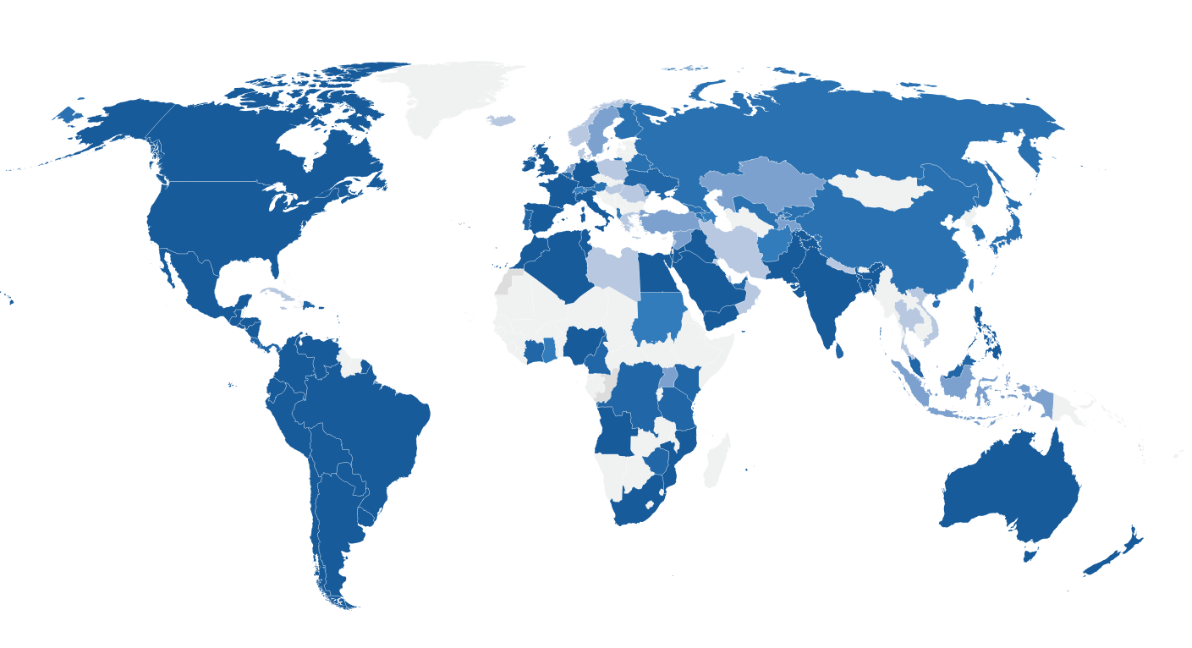
Data is available from 163 countries, including 70+ with annual samples of 1000+.
The data is freely available to all researchers from academic, nonprofit and governmental organizations.
Data is collected in 23 languages
| English | Finnish | Hebrew | Kannada* |
|---|---|---|---|
| Spanish | Portuguese (EU) | Arabic | Chinese |
| French | Portuguese (BR) | Hindi | Korean |
| German | Romanian* | Tamil | Japanese |
| Italian | Turkish* | Bengali* | Vietnamese* |
| Russian | Telugu* | Swahili |
*Forthcoming in 2025
To know more about the Global Mind Project
DYNAMIC ACCESS VIA BRAINBASE
Data is accessed through our Brainbase platform, where it is continuously updated as new MHQ responses are submitted – typically 1,000 to 2,000 per day. Users can search, filter, and compile datasets by country, language, age, and gender.
WHO CAN ACCESS THE DATABASE?
The Global Mind Project Database is freely available for non-commercial use and accessible to eligible researchers and organisations.
Non-Commercial Use
Access is granted to individuals and organisations whose primary purpose is not for commercial gain. This includes:
Universities and academic institutions
Public health and social service agencies
Registered NGOs and charities
Community Interest Companies (CICs)
Registered social enterprises
Before accessing the data, you’ll be asked to agree to our non-commercial use terms and conditions.
Commercial Use
All other individuals or organisations must obtain a Commercial License.
If you are interested in using the data for commercial purposes, please contact us at info@sapienlabs.org to discuss your needs
Terms and Conditions
To request access to the data
FAQs
Where is the data hosted?
The data is hosted on our in-house data repository called Brainbase (https://brainbase.io/)
How regularly is the database updated?
The databased in updated in real time as soon as a respondent takes the MHQ. Approximately 1000-2000 records are added per day.
Where can I find the data descriptions and other supporting information?
Information on the data descriptors and other supporting information can be found once you login to Brainbase. There are shared files that contain information on the column structure and data entries.
What file format is the data in?
The file is downloadable as a CSV file. You can choose to download all the data (warning: the file size is quite large) or you can choose to download a subset of the data using our data filtering interface. The interface allows you to filter by country, language, time, age and gender.
Is the data anonymized?
Yes, the data is fully anonymized. In the MHQ assessment, respondents are given the option to provide an email address to receive a personalized report containing their MHQ score. These email addresses are encrypted and converted into anonymized identifiers that can be used to identify repeat respondents within the data.
What is the IRB approval number for this data?
The data used in this study received ethics approval from the Health Media Lab Institutional Review Board (Office for Human Research Protections Institutional Review Board #00001211, Federal Wide Assurance #00001102, IORG #0000850).
Can I share the datafile with my colleagues or students?
Yes, as long as they are going to use it for not-for-profit purposes. However, it is better to get them to set up their own Brainbase account so that they can also be part of the community and receive updates about the data.
I am university course organiser who would like to use the data with my student cohort. Can I do this?
Yes, you can. Please get in touch with us at: info@sapienlabs.org so we can discuss your requirements.
How do I cite the database?
Please use the following citation for the database: Newson, J., & Thiagarajan, T. (2021, June 17). Dynamic Dataset of Global Population Mental Wellbeing. https://doi.org/10.31234/osf.io/vtzne
I’ve forgotten the password to my brainbase account. What should I do?
Go to the brainbase page ( https://brainbase.io/ ) and click on “Forgot password?”.
How was the MHQ developed?
The MHQ was developed based on a comprehensive review of symptoms assessed across 126 commonly used psychiatric assessment tools spanning 10 disorders including depression, anxiety, PTSD, OCD, Bipolar, ASD, ADHD, eating disorder, addiction and psychosis. The resultant 47 elements were then split into two formats: mental functions that could manifest as a spectrum from positive to negative and those symptoms that purely represented detractions from overall mental health. You can read more here and here.
Why did you develop the MHQ rather than use existing measures?
The MHQ was developed 1) for a general population to look across the spectrum from distressed to thriving and 2) to span the full breadth of potential symptoms. You can read more here.
What questions are included in the MHQ?
The MHQ includes 47 questions relating to mental functioning (27 spectrum questions, 20 problem questions). It also includes questions on life context factors that are important contributors to mental being. You can read more here.
What are spectrum questions?
Spectrum questions are designed to reflect the fact that the element could be an asset for some individuals but a problem for others. The scale for these questions therefore ranges from “It is a real challenge and impacts my ability to function”, through to “It is a real asset to my life and my performance”. You can read more here.
What are problem questions?
Problem questions are designed to reflect functions or dysfunctions that typically have a negative impact on someone’s life and could rarely be seen as a positive asset. The scale for these questions therefore ranges from “Never causes me any problems” through to “Has a constant and severe impact on my ability to function”.You can read more here.
What timescale are symptoms assessed over?
Both spectrum and problem questions are answered based on the current perception of the respondent. You can read more here.
How is the MHQ score calculated?
The Mental Health Quotient or MHQ is an aggregate metric of mental health, that positions individuals on a spectrum from distressed to thriving. It is based on an algorithm that thresholds ratings as negative and positive based on the severity of impact to function and applies a nonlinear transformation of the scale such that increasing negative impact to function is amplified. You can read more here.
How has the MHQ been validated?
The assessment has been validated for sample to sample consistency and MHQ scores have been validated as an effective measure of functional impact in various ways. First, MHQ scores linearly relate to work productivity including absenteeism and presenteeism and MHQ scores decrease systematically as the number of clinical symptoms and clinical diagnoses increase. The life impact scale has also been validated against other scales of frequency and severity of symptoms. Finally elements of the assessment have been validated against the PHQ-9 and GAD-7. You can read more here.
How does the MHQ relate to Mental Health Disorders?
The MHQ is a transdiagnostic measure of mental health and wellbeing. It was developed based on the symptoms asked about in commonly used mental health assessment tools and interviews spanning 10 disorders including depression, anxiety, PTSD, OCD, Bipolar, ASD, ADHD, eating disorder, addiction and psychosis and therefore contains elements that can be mapped to the disorder criteria laid out in the DSM-5. You can read more about this mapping and alignment here. Validation data across a sample of 174,618 respondents, showed that 89% of people who have MHQ scores in the distressed category range (MHQ score <−50) had symptom profiles that aligned with at least one of the 10 DSM-5–defined disorders. You can read more here.
Can I use the MHQ in my research?
Custom versions of the MHQ can be developed for research and/or measurement of mental wellbeing of specific populations (e.g. Employees of a particular Company, University Student Body, Municipality etc). To inquire about creating and using a custom version please contact callyn@sapienlabs.org
To request access to the data
Any questions? Email us at info@sapienlabs.org