
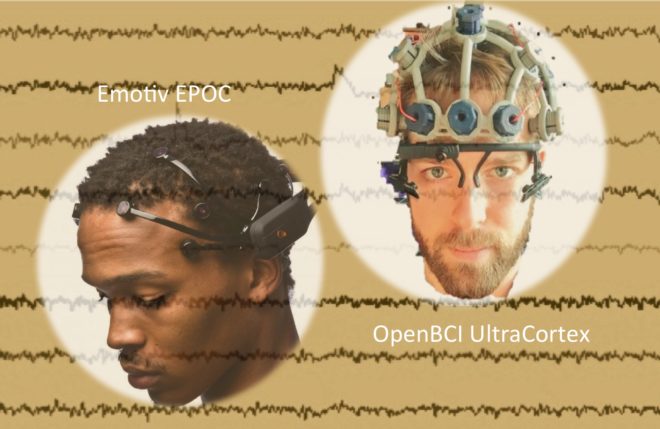
Emotiv EPOC and OpenBCI UltraCortex are the two lowest cost portable research neurotech devices on the market (see Taking Neurotechnology out of the Lab for a full list of devices and background) for measuring EEG signal. At the relatively affordable price point of ~$1500 – $2000 they occupy a unique place in the market.
While both devices basically measure the same thing and have a similar signal quality (there are of course some subtle technical differences when it comes to the signal quality depending, which we’ll get into in detail in subsequent posts), there are some pretty big differences in other aspects. If you are thinking about getting one of these headsets so that you can venture into the wild with it here are some things to consider.
Style and Assembly
 The Emotiv EPOC has 14 channels + 2 references at the mastoids and is all about design and a slick user experience. It pops easily onto your head with no assembly required, although you have to wet the felt contacts with saline solution (basically reNU or whatever you use for contact lenses), and screw them onto the device first, which can take a few minutes. It probably looks the most stylish of all the portable EEG devices out there. To just get going and not think about the hardware, this is a great piece of equipment. It’s easy to order, ships quickly and has always worked well for us.
OpenBC I’S UltraCortex on the other hand has a maximum of 16 channels and is designed for DIY hardware enthusiasts with everything exposed for open view. This is the opposite of the EPOC where everything is neatly encased. For someone focused on the signal and its use rather than the assembly of microelectronics, OpenBCI can be a confusing purchase to navigate. The pro assembled version is also often not available due to backlog. The big advantage of OpenBCI, though, is that it is very modular so you can fix and replace parts that break, which would allow you to forgive the nerdy looking 3D printed headset (we say this in a nice way).
Pricing Models
Their pricing models are also different – for its complete fully assembled system OpenBCI charges about $2,000 which gives you access to all the data in raw form and the ability to apply your own data filtering (this is an important upside). The EPOC, priced at $799, doesn’t naturally come with access to the data. However, you can get access to the data (post the application of their own signal filtering) with a monthly subscription of $49/month, which can end up being more expensive in the long run. Given this, using the EPOC requires Internet connectivity, but if that’s not a problem then you’re good to go.
Sampling Rates
First thing is that the digitized output is at 128 Hz for Emotiv EPOC and 125 Hz for OpenBCI (pretty similar) compared to 512 Hz or 1 kHz for the highest end clinical devices (check the table at the bottom of this post for a tabular comparison).
This is because when you go wireless, you can’t stream that much data even though the internal sampling frequency is comparable to the expensive clinical devices (~2 kHz). The internal signal is not accessible in the EPOC where everything is encased, whereas in the DIY, modular design of OpenBCI, you could snap the Micro SD card out of the board and get access to the internal signal, if you were really that motivated (though for most things you really wouldn’t need to).
Signal Filtering and Preprocessing
In Emotiv’s EPOC you can only access the processed signal after their offline filters have been applied. The filtering is totally reasonable though – they apply a low pass filter of 85 Hz and high pass filter of 0.1 or 0.2 Hz. However, they also apply both 50 Hz and 60 Hz notch filters, which give you an effective range of 0.2 – 43 Hz. The notch filters are to remove the utility and power line frequencies that get picked up as noise, which are 50 Hz in most of the world and 60 Hz in the US. That’s covering all bases, but if we could have our say we’d want to have only one notch filter which we could select only if we are seeing evidence that the noise is being picked up.
OpenBCI, in contrast, lets you set your own filtering in the GUI which is cool because the notch filters still lob off a lot of the high frequency signal and you really need only one or the other – depending on where you are. You can also pick different bandpass filters in their GUI. Their primary filter is a 1-50 Hz bandpass, which is OK. Of course you can just take the unfiltered data and do your own filtering so you have all the flexibility but it would be nice to have some options that capture a larger range (say 0.1 Hz to 60 Hz or even 100 Hz, assuming you might skip the notch filters.)
That said, if you just want to be safe and don’t want to mess with this aspect, then just going with all the default settings of either device is really OK – you’ll miss some things but there is still a lot of information in the signal.
Bottom Line
Now, obviously you have to give up some things when you go from a $25,000 or $50,000 device to a $1-$2k device. What you lose here with these devices is predominantly the high frequency component of the signal and some extra channels. You do get additional information at higher frequencies and can do more cool network analysis with more channels, however, 0.1 to 50 Hz really gives you a lot of signal to work with and even single channels have some interesting stories to tell. Indeed, if you look at the EEG literature, most only involve analysis on the 1-50Hz range anyway. Bottom line, the signal is good enough for many things (we’ll do a *serious* deep dive into signal quality in an upcoming post), and we think they’re both awesome and a great step forward so check them out if you haven’t already www.emotiv.com, www.openbci.com.
Here is a research paper by Jeremy Frey, comparing OpenBCI to a medical grade device for BCI applications. OpenBCI does quite well in the comparison,
https://hal.inria.fr/hal-01328427/document
Also note that OpenBCI samples at 250 Hz, when used in 8 channel mode. Higher sample rates are possible using an opto isolated wired USB link, documented on our forum.
Regards,